2-3-4 Friday 12 Apr
‘Seeking to spark the most potential within you per word of any online newsletter’
1 thought
In January 2023, I spoke to another guru in the
organisational development space, who will remain unnamed for reasons of confidentiality.
He said something that surprised me.
When I opened the conversation around how his start of the year had been, he said,
I’ve not been busy. But I’m happy.
When I expressed surprise and asked how he did it, he said,
Yes, I’ve deliberately unpacked my schedule.
When you look at him move, he’s languid, slow, and you wouldn’t expect him to be leading conversations about the nature of organisations, and how to design them better.
But he is.
For a long time, I struggled with this idea of slowing down, and being productive, whilst being slow…
Until I read Cal Newport’s latest book, Slow
Productivity.
It’s easy to say slow down. But many would expect that slowing down would come with an accompanying reduction in productivity.
Yes perhaps, but the question we should be asking ourselves is,
Are you tired?
Because if you
look at the nature of work today, where you’d probably
- start your day at 710am in the morning,
- before squeezing open WhatsApp, Telegram, and emails to check what you’ve missed, perhaps having a few skips of your heart as you realise what you’ve missed
- Then slowly lumbering to the toilet to brush your
teeth…
- And then rushing into the morning rush hour on the roads.
It’s not a very sustainable way to live.
How long can you go on like that, at this speed?
Some have told me,
John,
this is the world we live in. You have to face reality.
You can’t just escape from it.
Sure you and I can’t.
But what’s a more sustainable way?
I think Cal offers a different way.
1 talk
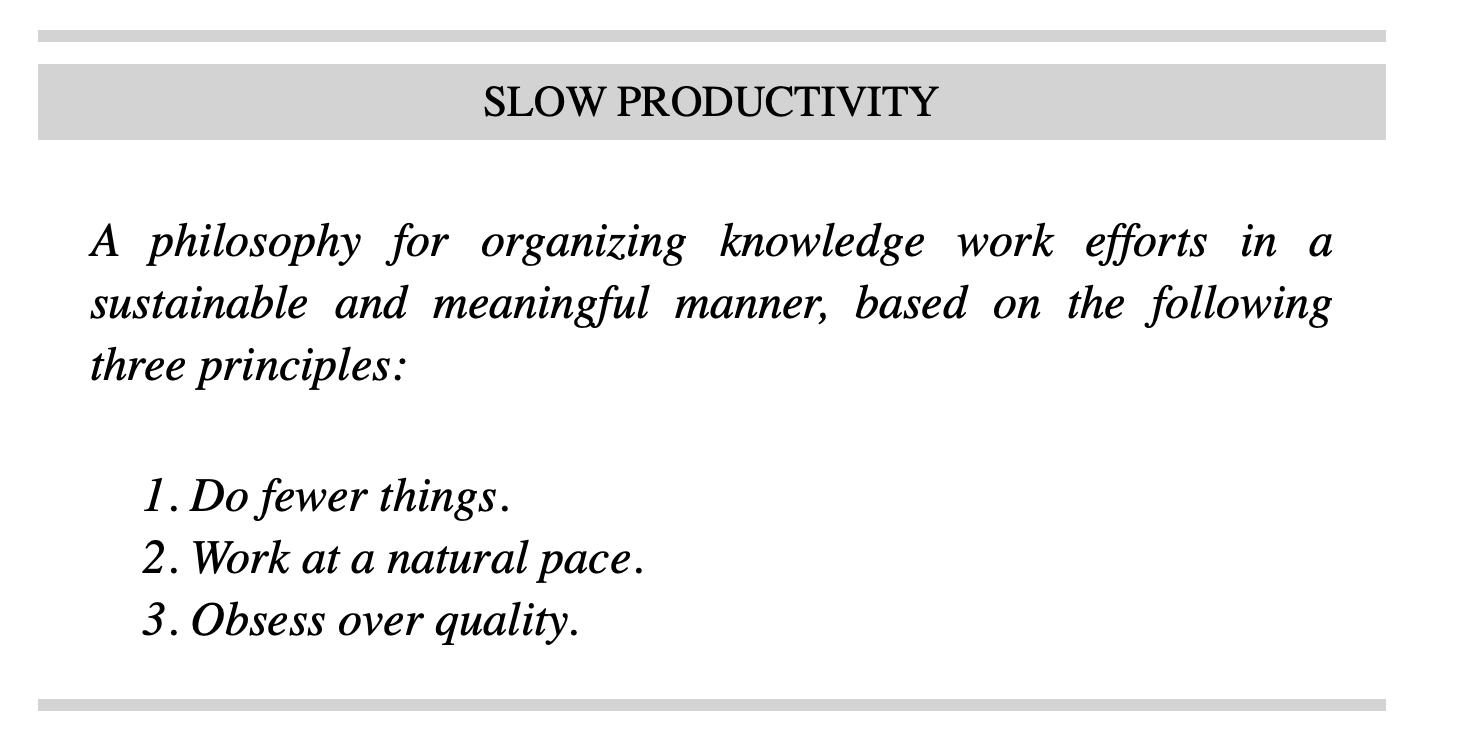
Slow productivity
A philosophy for organising knowledge work
efforts in a sustainable and meaningful manner, based on the following three principles:
- Do fewer things
- Work at a natural pace
- Obsess over quality
Cal Newport, Slow Productivity
1 tip
Let’s focus on doing fewer things, because I often think we, as humans, have a tendency to push ourselves out of whack by taking on more commitments than we can realistically take on.
Often the question that we are asked
is,
Can you do this?
I think the question we should be asking ourselves when we are faced with such requests for our time is,
How can I not do this?
What would happen if I don’t?
In Singapore we call that ‘jiak zhua' (Hokkien for ‘eat snake’ - or evading work’).
In the last few years, it’s been called quiet quitting, where workers no longer take on healthy, citizenship behaviours that make work easier, like:
- Offering to help with writing the minutes, or other boring things that no one wants to do;
- Supporting with projects that are voluntary, and not part of one’s job, like organising the team retreat event
I think there are times when it’s good and healthy to recognise that one is stepping back from giving one’s all in work, and reallocating that time towards other more pressing priorities, like family, being with one’s child, or one’s friends.
Thus, part of this concerns our work, whilst the other part concerns the extra projects we have in our life.
When we ask,
how do I not do this,
and what would happen if I don’t?
We begin to see that we
don’t have to do everything.
The next time someone asks you for your time, check yourself and ask,
what’s the worst thing that could happen if I didn’t do this?
John
Live Young, Live Well - Work Your Love
Think others might benefit? I’m counting on you. Forward this on.