2-3-4 Friday
‘Seeking to spark the most potential within you per word of any online newsletter’
1 thought
As always, thanks for
reading.
I’m writing today about how this newsletter is shaped. I know some of you have come to this newsletter as a result of savethesocialworker.com, the first site I created for social workers, to
help them deal with issues such as:
- How to write case notes faster
- How to handle caseloads more efficiently without burning out
- How to manage difficult clients
But over the years, I’ve adjusted some of my work after realising that social work wasn’t working out for
me, and seeing that there were other ways I could add value to this world.
I’ve kept this newsletter as a discipline to share ideas that inspire me, primarily around this core question,
how can you have better health,
be happier,
and hustle more
effectively?
If we think of these three things as points on a triangle, then we realise that doing these three things well isn’t about trying to balance those three.
It’s about focusing on one aspect - intensely, whilst being mindful of the cost it is taking on the other two aspects.
For example, many of us look up to founders and businessman have become the unknowing gods of our age. They are the ones we worship and want to be like.
But we don’t realise the cost that many of them go through to become who they are. You hear stories of them sleeping under their desks, losing their health, and being entirely unhappy for years just to build something.
So if you want to hustle hard, don’t try to optimise for health and happiness at the same time. You’re bound to fail.
Back to the point of this newsletter.
In this newsletter, we primarily share stories from Asia, as we think there are many inspirational stories in this region that aren’t given as much
focus.
We hope this newsletter gives you:
- Ideas to think differently about a problem
- Implementation ideas to do yourself
With that, let’s hop back into another story.
Yesterday, we were
working with a senior leadership team to do a strategic retreat. One of the key management personnel there was a man who had come with a vast background in hospitality, having worked for some of the biggest names in the hotel industry. He had worked in different continents.
When he came to the club, he was notably taken aback by the culture and how different it was. He found it difficult to attract staff to do the menial F&B
type jobs, that were lowly paid and difficult. The better ones would go to the highest paid in the industry.
So he changed the offer. He told staff about how there was a different customer profile they were serving. In a hotel, they would see a different person everyday. But in a club, with a golf course, they were serving the same person weekly, and there would be the chance to build a long-term relationship. The club members
would take interest in the staff’s welfare, family, and occasionally give a tip.
Of course, the staff weren’t just there for the tip, but the tip did sweeten the deal.
Those who worked in the club were given a mindset shift. They were told about how there was more stability, less change in customers served, and how they could prioritise other things in their
lives.
That’s smart.
In my first year of my full-time job, I was constantly frustrated about how the organisation didn’t seem to fit my growth ambitions. But it was not till later that I realised that there were different organisations for different ambitions.
If you find yourself unhappy at your job today,
maybe a good question to ask is,
is this the right type of job for me?
1
talk
“The three big ones in life are wealth, health, and happiness.
We pursue them in that order, but their importance is reverse.”
The Almanack of Naval Ravikant: A Guide to Wealth and Happiness, by Eric Jorgenson
1
tip
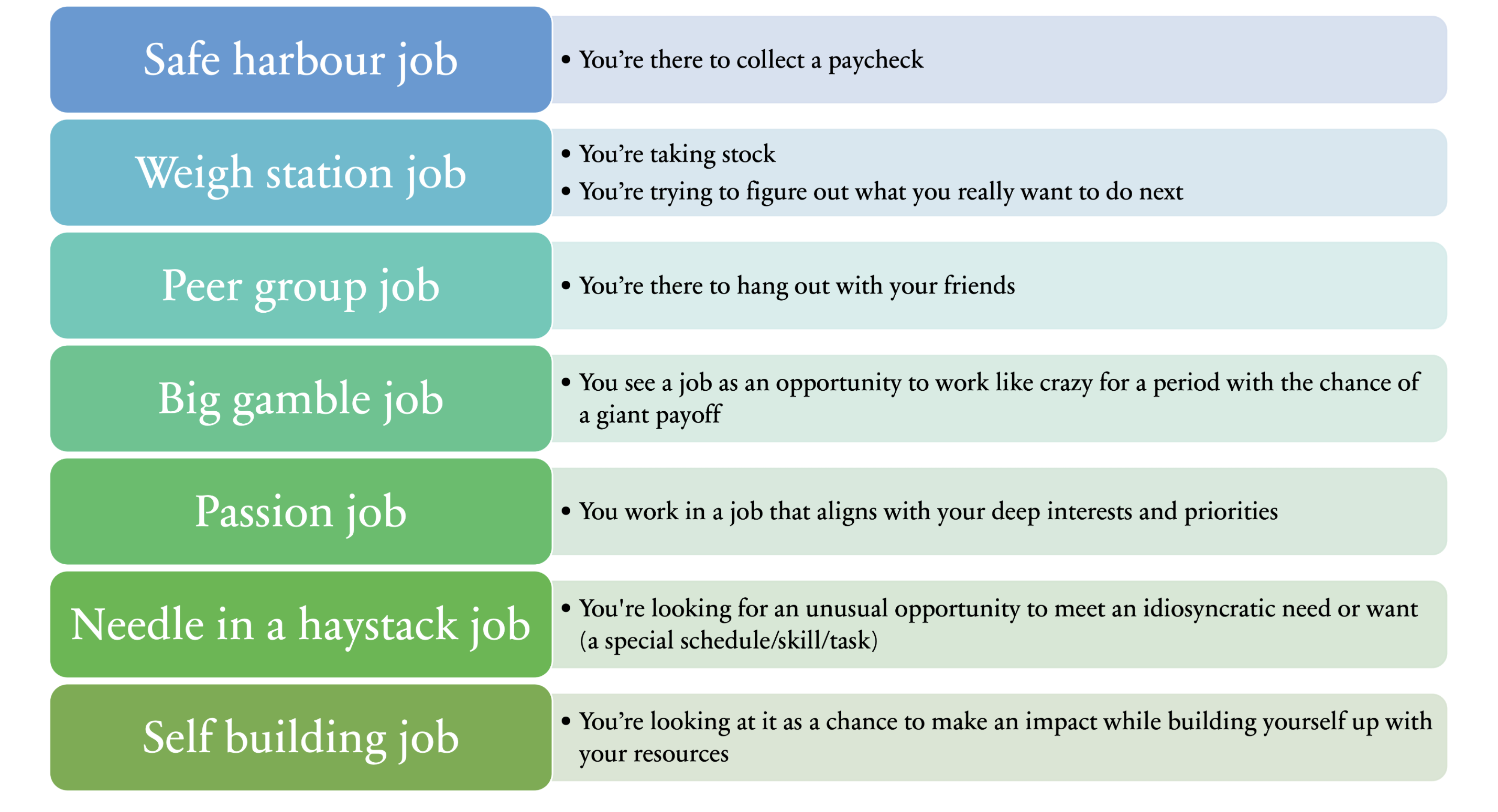
In general, as Bruce Tulgan wrote in his book ‘Not Everyone Gets a Trophy’, there are 7 different types of jobs.
Know what you’re primarily there for, before you go complaining to your friends about why your job seems so bad.
Bear in mind - primary means
one.
One single priority is going to be easier to reconcile than 3 different priorities.
One mistake that often happens is that we have conflicting priorities for a job. In my first job, I made the mistake of thinking that I was there for the ‘passion’, when in fact, the job was more a way for me to weigh my options and to think about what I wanted to do
next.
There’s nothing wrong with that.
Own that priority (however seemingly selfish it seems), rather than trying to achieve too many things at the job at once.