2-3-4 Friday Reaching 100k
‘Seeking to spark the most potential within you per word of any online newsletter’
1 thought
This is a longer piece about how I saved 100k of assets,
whilst taking home $970/month for the last 3.5 years. Please do not carry on reading if you do not like to hear about money.
In December 2016, I went on a trip to Iceland. Whilst driving down a mountain in a tiny Volkswagen Golf, I couldn’t see much in the snowstorm. The wind speeds were 34kmh. As I drove at 30km per hour, I suddenly hit something in the snowstorm. The alarms in the car started going
off.
Not knowing what was happening, I got out of the car quickly to check. I nearly got blown away in the snowstorm.
Not seeing anything, I went in, and continued driving down. By the time I reached the airport to fetch my friend, the car died. I had to pay SG$11,200 to replace the car, which had been totaled.
I was all of 21 years old.
In July 2021, my entrepreneur friend came with a proposition. He told us that he knew of a friend who was earning 7% per week by trading bitcoin on leverage, and he asked if we wanted to give him some money to invest.
Not knowing where to get these kind of returns, I promptly gave him another
$10k.
His friend promptly lost all $1.2m of our monies during a particularly sharp fall in bitcoin prices, in the span of a week.
I was 26.
In October 2021, I left my $3690 social worker job, to find another job. No one would offer me a job.
For the next few months, I survived on $400 a month doing random bits of writing.
By this point, if you’re reading this and thinking,
Wow John is one stupid guy…
I would forgive you.
Because I am.
Yet on June 5th 2025, the valuation of my stock portfolio crossed SG$100k.
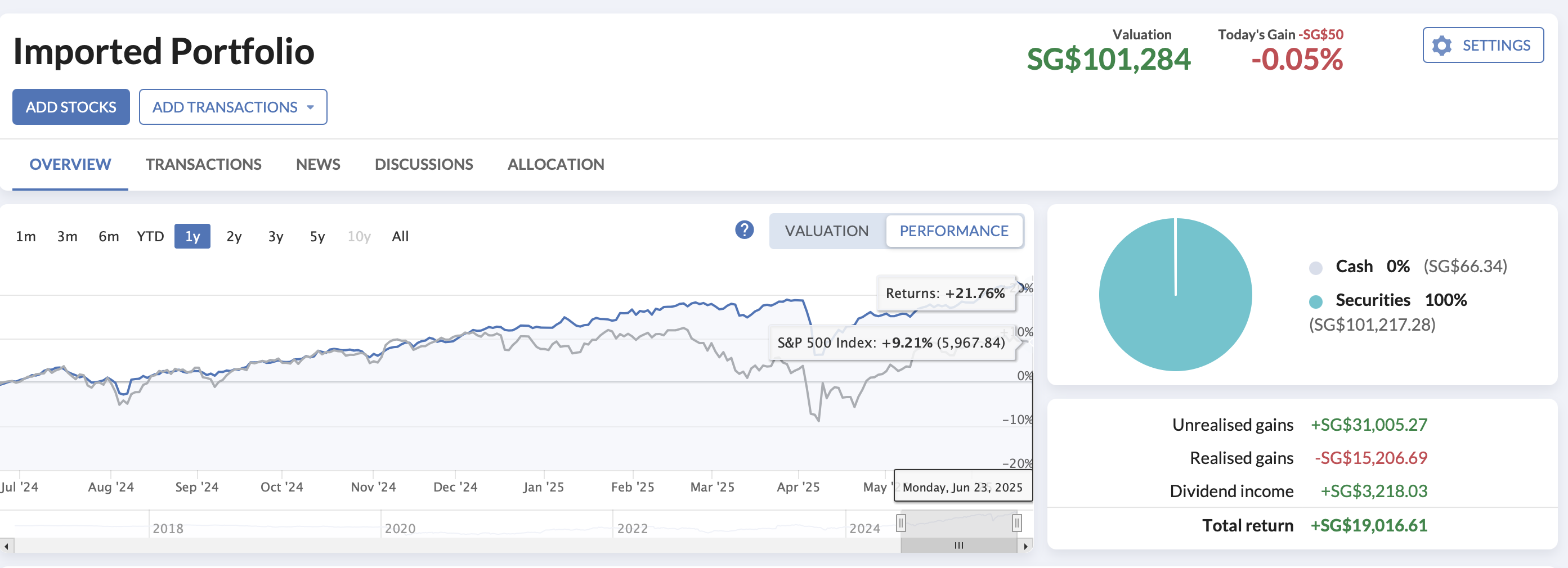
I was 29.
I don’t say this to boast. I think others at 29 have much bigger portfolios, and are definitely much more accomplished than I am.
But I say this because I want to share one simple idea.
I’ve failed alot. But I’ve learnt that there’s a far bigger
tolerance for failure than we care to admit.
The tolerance for failure is far larger than we expect
Since October 2021, when I formally left my job, I’ve been using the bare minimum to survive. It’s an average of $970, and the rest is reinvested in the business.
Then you might
ask,
okay, how have you still managed to build up assets?
The only reason has been because I’ve admitted to my mistakes.
Since I started investing as a 20-year-old, the majority of the stocks I picked were wrong. Out of the 21 stocks that I chose whilst I still had a salaried income,
13 of them lost me money. This meant that I was turning gold into lead, losing money with 61% of my choices.
61%!
But what was important was how I faced up to my stupidity, sold the bad stocks, released cash, which I recycled into better stocks.
So it’s not what you do in the leadup to your
decision, but in the lead down from your decision. It’s how you materially adapt to your decision, rather than how great your first decision is.
Your initial decision can be made with as much wisdom as possible,
but your follow up needs to be better.
This expresses itself in many
ways.
You’re scared to quit a job because you’re worried that it’s a wrong decision.
You’re worried of losing money when you start a business. But it’s not about the decision you’ve made.
It’s how you adjust after you’ve made the decision.
My first career as a social worker was not the best fit for my character, and I promptly left after 2 years to run the business I’d started in June 2020.
When we incorporated in June 2020, the first business model for the business was running training workshops. It earned me all of $6300 after 2 years.
In July 2021, the second
model I pivoted to was writing content, and earned me a miserly $600 per month.
I started doing websites. Then marketing. Then process facilitation.
Eventually I realised that I could only earn more by packaging design, writing, and marketing into a neat package like print publications. Schools’ yearbooks. Annual reports. Ghostwritten
books.
Iteration is a painful process.
But most people would rather stay struggling than struggle to get correct.
Changing things when things are not going as what you’d expect is hard. A story I often recall was my own desire to stay on as a social worker in the charity
even though I had just been issued with a Performance Improvement Plan.
And even though I had just been offered another organisation’s Project Manager role, to work with an excellent CEO.
I was scared that I would not perform in a better role, even though I sucked as a social worker.
Peeling off
the plaster is painful, even though you need to let the wound heal.
Eventually, when contract renewal talks came up, I thought - no, it’s time to move on.
I didn’t know where I was going, but moving on first, before deciding what next, put fire in my belly.
I now had no more fixed salary, and I
had to earn - or die. The simple answer here isn’t to quit your job when you don’t like it, but to ask yourself,
if I was still to be in the same situation in a year’s time, would I see it as a loss?
Starting before you’re ready
None of us ever know when’s the right time to
do something. The problem is, most of us wait until we are ready before we do something. We tell ourselves, if only, if only. I was lucky because in my first job, I had a Performance Improvement Plan that showed me that I didn’t fit well. The second job I had was clearer - you resign, or we terminate you.
We don’t always have such clear signs about when it’s time to leave, or time to do something that we think is right for
ourselves.
Over the years working with many different people who’ve wanted to accomplish different things, when I hear their dreams, I will tell them what I would do if I were I their position. Often their reply then becomes a series of defences
- What if I didn’t get X?
- What if I didn’t sell
enough?
So then I ask them,
is it okay for you to lose everything you’ve put into this project? Money, time, effort?
People often say yes to this, and when you check in a year later, they still haven’t moved many things.
On having a sense of abandon around what you do
During a recent training I was at with Tong Yee of And, he remarked that he spotted a “certain sense of abandon” around me.
In the leadup to Christmas 2015, I would stand on a chair, and look down the 14 stories of my apartment block, and wonder if I should flip myself over.
I didn’t, because I was scared.
I was 20.
When I didn’t, I realised that everything I’ve had since then (scholarship, social work, business, assets), is simply a show of God’s grace (or for those who are not religious, luck).
Because I had little to start with, I had nothing to
lose.
Having an abandon around some of the things you’re trying to start can help. Some questions that have helped me when I struggle to move things:
- Why be so precious about something that isn’t yours to begin with?
- Personally I believe that my ideas aren’t mine to begin with. Because they are inspired by
emotions, God, all I can do is to be a willing and clear channel for these ideas to come to life.
- It’s easier to raise standards, and what customers can expect from you later, than to drop standards after you’ve set a high bar at the beginning.
Having a wild abandon around you isn’t always the best idea, but it helps us to be less precious about what we do,
so we birth more than what we say.
Being willing to lose
In July 2023, over our weekly Zoom call, my software engineer announced that he was going to be looking for a new job. I sat in shock, wondering what next. I had let him down. I had told him that I was going to be closing more sales, and he had been willing to put off his job search for 3 months to
work with us for a pittance.
This was my second team, and the first had just broken up in September 2022 after I failed to find a profitable product-market fit.
None of these failures are ever easy. Some people think I’m flippant when it comes to work, seeming ambivalent about what the work looks like.
I don’t think it’s that.
It’s just that when you’ve lost so many times, you get used to your next project, and you recognize that you will give your all, but you may not get what you want.
It’s not your fault. It’s your fault if you didn’t try. But you did.
If I could sum up the foremost
lesson I’ve learnt over 5 years and 3 months of running a company, it’s about
being willing to lose.
That lesson works for life, relationships, investing.
When you accept loss as a plausible outcome, you give it your all, but you don’t hold onto the outcomes too
tightly.
1 talk
Ultimately, your greatest failure is not because you tried and failed,
But that you failed to try.
1 tip
What idea have you been
holding back for a long time? What’s the smallest next step you can take, and keep taking to make that idea a reality?
John
Live Young, Live Well - Work Your
Love