2-3-4: How to ensure you're not replaced by cheaper labour
Published: Fri, 07/18/25
Updated: Fri, 07/18/25
Pragmatism calls for a race to bottom. Here's how not to lose.
2-3-4 Friday: Quit before you're ready
‘Seeking to spark the most potential within you per word of any online newsletter’
1 thought
One and a half years ago, I was in
Aichi, home to the Toyota group, and known as the industrial heart of Japan. That day, my host brought me to a local library and I was surprised to see that there, librarians were still sitting, checking out materials for residents.
Compare this to what you see below, a typical scene from a library in Singapore.
No need for staff, all you need is to turn up with a card, check out the books yourself, and you’re done.
Smart, efficient, and definitely useful.
If you’re a reader, you seldom think about the librarians who were unfortunately replaced by these machines.
But over the past few months, I’ve been hearing more and more about the difficulties of ordinary Singaporeans, whether they are being out-competed by cheaper and better talent from abroad, or whether they are simply no match for the technology that faces them.
The
narrative is that these people who are replaced can ‘upskill’ to better jobs, but we know the reality is not that simple.
There’s one part of the problem where it’s really difficult if you’re 40, and suddenly realising that your job is close to obsolete.
But during a recent conversation with a friend, he told me about how his contract with Unilever had not been renewed, and his job nearshored to Thailand.
He was from the National
University of Singapore, and all of 31 years old.
It can seem doom and gloom, but the hope here is to ask if there are positive deviants amidst this.
An acquaintance I recently spoke to left a great job in a business, where she was being primed for bigger things. When I asked her why she left, she said it was because she didn’t see a promising future for the business.
She did not agree with the business direction and thought it was better for her to
move onto something else.
Make no mistake - the business was still doing well.
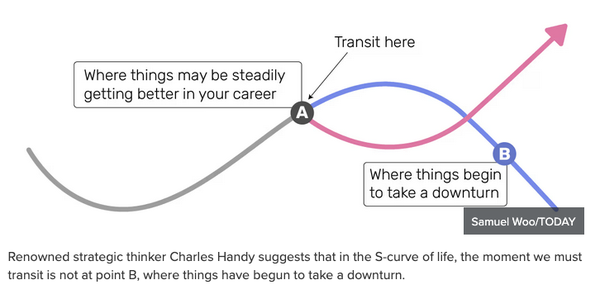
The key lesson here, was that she learnt to quit, when things were good.
1 talk
Quit and progress yourself, not when it’s needed, but when things are good.
1 tip
Quitting and reinventing yourself is not a new idea I’ve introduced.
But it’s something we often resist because we’re afraid of change.
When things are going well, there are so many more things you can focus
on. Finding your holiday, buying a house, doing better things - why bother with improving yourself?
I don’t think it’s just so that you can get a better job. Nor to protect yourself from losing your job.
But I think it’s to ensure that your core skill still benefits as many people as possible.
In February 2021, after COVID started, my then charity started looking to upgrade our IT infrastructure. It was not something unfamiliar to me. It
wasn’t my job, but I went to get quotes for virtualization through VMWare, and cloud computing on AWS. Despite all the work I’d done, the charity decided then to install on-premise servers with bigger storage, even though
I pointed out that they would probably need to upgrade this again in a year.
They did upgrade it in a year, and subsequently decided to virtualise their systems on VMWare.
For me, that was a clear example of how we often see our
own skills upgrading. We deepen our skills in a specific niche; whilst not looking outwards to see if this skill is even relevant.
If you’d like to stay relevant, don’t just look for the latest trending skill (like AI prompt engineering). Rather, look for the skill that’s complementary, relevant - and something you’re willing to deepen over time.
Don’t quit when you’re ready. Quit and upgrade, before you need to.