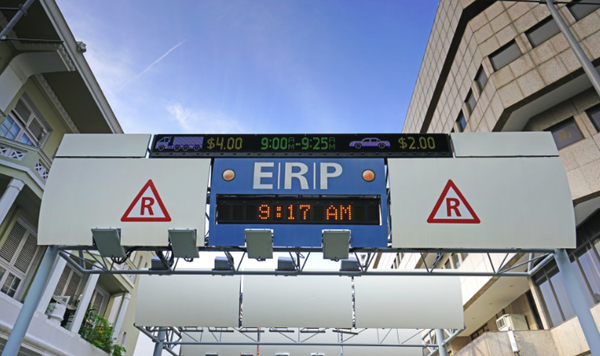
I used to think that was a great thing, until I realised the one thing that these countries weren’t necessarily stupid.
They were providing jobs for their people.
You will see it everywhere else. I once went to an apartment block in Johor, and at every gate, there was a security guard. In Singapore, all you have is one guard at one security post.
In Singapore, we do
what’s efficient and pragmatic.
And you slowly come to realise that Singapore is no place to be mediocre, average, and entitled. Some people think that Singapore should be a safe place where they can get good jobs, but we often forget that our first shared value is:
No one owes us a living.
The Singapore Government’s narrative is about how we need to move to higher value jobs. There’s nothing wrong with that. But then
the question becomes,
how do you ensure people don’t get left behind?
Or how do you avoid what happened with the US, where manufacturers hollowed out to cheaper countries?
Going on about our social contract with the Government of the day can be a deep philosophical argument, but I’ve come to learn this:
If you don’t take care of yourself, no one will.
Just take the last four years, where
I’ve been rejected for 471 jobs, 47 interviews, and ended up having to fend for myself.
In many ways, I’m grateful for that experience.
Because I used to feel entitled and as if I deserved to have opportunities, just because I was ‘an overseas scholar’.
A while back, I was at an event organized by REACH, Singapore Government’s feedback unit. That evening, many complained about how they felt foreigners were not working as hard as them, and
that these foreigners were still getting the credit for work.
They complained about how they felt more uneasy about the future of their jobs, and how there seemed to be an increasingly broken social contract between the people and the government.
One story stood out, and it was how a young 34 year old investment banker, whom I thought would be rich and powerful, was complaining about how he didn’t feel like he was earning alot.
He spoke
about how he was working very hard, over the weekends, and still seeing his colleagues not work as hard as him.
And yet, they were getting the credit, not him.
I told him,
but you’re the one learning, not them.
They learn nothing by shaking their legs and twiddling their thumbs.
Hmph, he said.
He was clearly not convinced.
1 talk
When you
feel like you’re owed something, you finally realize that you’re living on someone else’s terms.
1 tip
And so today my question to you is,
where do you feel that you’re owed something?
I don’t think the answer here is to tell you,
stop feeling entitled.
But I think it’s more vital that we learn how to start with the mindset that no one owes you a
living. And that’s actually a good thing, because it means your potential isn’t capped.
Because what we are really saying when we think we deserve something, is that:
- Someone should recognize and validate me for the work I’ve done.
- Someone should give me what I rightfully deserve.
There’s nothing wrong with asking for that, beyond the fact that doing that means that we are always, always living on other people’s terms, rather than on
our own.
Because you feel a sense of injustice, or that someone should do something for you, when you look externally. You’re anchoring what should be done for you based on what you see in your limited world.
For example, why do some of us believe the Singapore Government should bring better jobs to Singapore, and protect our jobs from foreign talent?
Because the strangest thing was that when I was in Thailand, and I asked my friend why no
one seemed to be angry about the government not solving the economic problems, she laughed and said,
you should be thankful the government is not making more problems. Solve them?
You can keep waiting.
Different contexts, different expectations.
I will close with this story.
When I dropped out of formal employment in October 2021, I happened to pass by a signboard that said, “Young Leaders’ Dialogue”. It was held in
a swanky office building, and I had just come down after interviewing someone for a book I was writing. As I passed it, people sat inside, with nicely pressed dresses, neatly coiffed hair, nodding with their Cheshire smiles.
I was jealous.
I wondered why it wasn’t me sitting inside.
It wasn’t until much later when I looked at my watch, and realised that it was 520pm, and that I could have the freedom to do whatever I
wanted.
I didn’t have to answer to the bosses, to colleagues, and I was finally living life on my own terms.
We can feel entitled for all we care, but there’s always a cost to that.
Entitlements come with responsibilities, and those chip away at your freedoms.
So here the question remains,
what freedoms are more important to you,
and whose terms are you willing to live
on?
John
Live Young, Live Well - Work Your Love