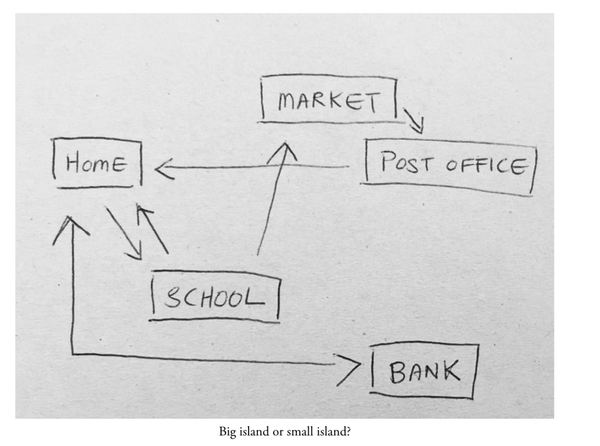
Credit: Teo You Yenn
This isn’t the life for most of us. Whilst we do suffer the commute to and from work, most of us have options. During the weekend, we can hop across the Causeway to Malaysia for some cheaper Japanese sushi, have a foot massage, before heading home, $170 poorer, but
fuller.
The boy in that single parent family I served would often find his weekends spent in the same small flat, with nothing to do. One of my earliest interventions was to bring him out for movies, iceskating, doing things 13-year-olds would do, but which his mother had neither time, nor the money to afford.
None of this is written to guilt-trip us and to make
us think that we should donate more, volunteer more time, to these people. But it’s simply to make us aware of the options that are open to some, and the doors that are closed to others.
It’s always easy to compare lives, and we do often compare to those whose lives are better. We seldom look at those whose lives are filled with more suffering than ours.
What’s perhaps more useful is to see what we can learn from the lives we work with.
Are options always good? Or might having more closed doors sometimes lead us to clearer decisions?
I think closed doors can sometimes help. Because when you’re stuck between a rock and a hard place, you learn to make the best of what’s remaining to
you.
1 talk
我从来都不在乎 自己不是一个大人物 (I’ve never cared, that I’m not famous)
因为平凡也是一种幸福 (Because being ordinary is its own bliss)
- 小人物的心声 (Ordinary People), Chen Wei Lian
1 tip
In one large family I worked with, I used to go to their small 1 room apartment. They would all sit on the floor, whilst offering me the only stool in their home.
The mother would calmly share what she was going through, her financial troubles, her difficulties supporting 6 other children, and how her ex-husband was not paying any maintenance.
When I asked what her oldest was doing, she would proudly say that he was going on to study lift maintenance.
I paused and wondered if that was a good career. In my limited view, repairing lifts didn’t seem ‘professional’. Was it?
In modern Singapore, being a tradesman, like a lift repairman, was a dirty job that no one wanted to
touch.
But try fixing your own car, and you quickly realise the value of such skilled tradesmen.
Often when you have few options, and the options in front of you seem poor, all you can really do is to make the best out of it. It seems cliche, and ordinary advice, but you would be surprised at the number of people who complain about the jobs they have, whether
they are clean or dirty.
How do you make the best of something ordinary?
The usual advice - don’t compare, be grateful, all feature. But I think sometimes, it’s simply as simple as keeping your head down and doing the work as well as you can. You can grumble, hate the work, but that’s only going to amplify your suffering.
So why not try to enjoy the work you have? Or if you don't enjoy it, at least give it the best you've got?
John
Live Young, Live Well - Work Your Love