2-3-4 Friday
‘Seeking to spark the most potential within you per word of any online newsletter’
1 thought
I put $1m with HSBC. Another 500k with Citibank.
With OCBC? Nothing.
Why? Because your relationship managers have ethical problems. Can you imagine? She’s asking me “how’s your relationship with your wife? I’m not very happy with
my boyfriend.” Is she trying to ask me to be her sugar daddy?
I wince.
There are 1800 people in the hall, there for the Annual General Meeting of OCBC, a veteran bank in Singapore. We’re supposed to discuss strategic matters regarding the future and the present moment of the bank, but this man is going on a long tangent about his personal experience with OCBC.
Just the earlier week, during the AGM of DBS, another bank in Singapore, man
after man came up to complain about their experiences with DBS.
You’d think that these well-to-do men know when the right time and setting for such things are.
But it doesn’t look like it.
It reminded me of the time when I was a fierce advocate, constantly speaking up and trying to change things. I was a good writer, and had a good hit rate with pitching and getting my stories featured by the media.
One of the
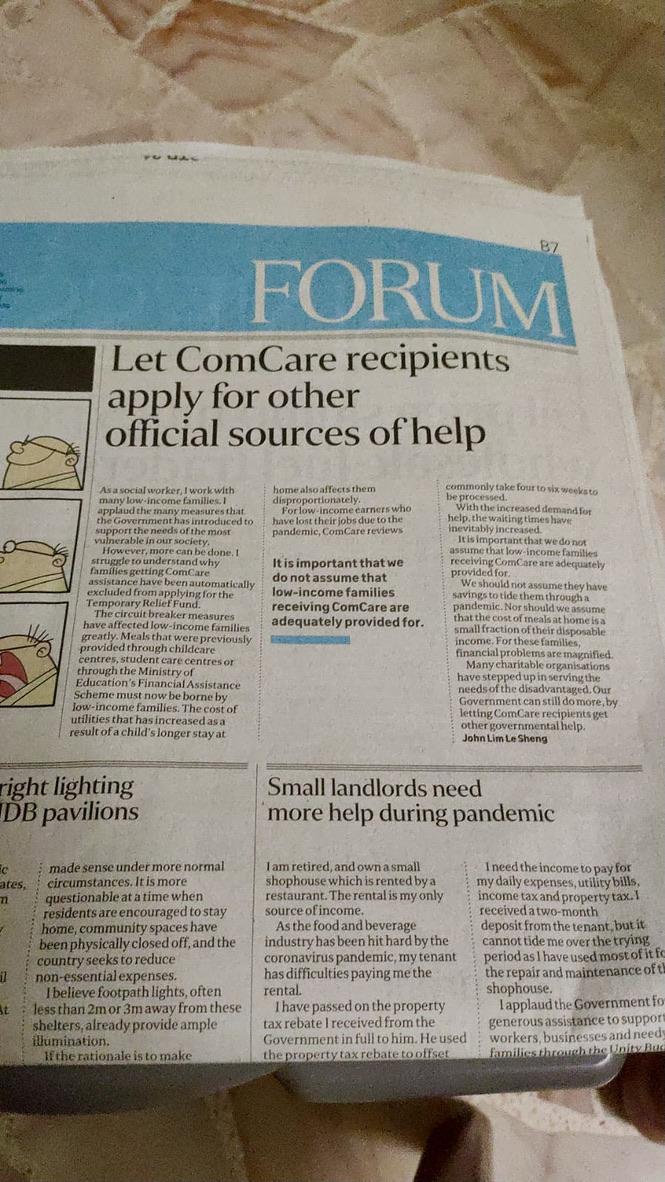
first letters I did for The Straits Times was about how we should let those receiving official government assistance apply for more help.
Without going into details, I got some flak from my then employers.
Recently
someone asked me if I’d lost the passion for advocating, and if I’d just become more clear eyed about what such advocacy did.
I think so. There’s a role for advocacy, but only when you’re clear that you’ve exhausted most options.
No one likes being stuffed and shamed in front of national media, and to be forced into a corner with national attention on you. You’d expect them to be even more averse to what you say.
Over the past few
years, I’ve been trying to advocate alot for social worker welfare, and I realized that I was always fighting with key authority figures. It came to a point where a mentor told me that a senior establishment figure had spread word about me, reducing my chances for being hired. That was when I began to realise how unhelpful this was.
I had to be inside, to make some sort of difference.
1 talk
To push people to do something they are
resistant to, it helps if you’ve a good relationship with them.
1 tip
Over the past few months, I’ve slowly begun to see just how to shift things.
- By having a hypothesis, rolling up your sleeves, and doing the work.
Yes, talking can be helpful. Advocating, shining a light on it can be, too. But often, that doesn’t translate long-term.
So then the oft-cited question that donors
ask is,
“how long-term can we make this?”
For example, in the work we do now with ex-offenders, the challenge is recidivism. How do we make them sustain the change they find in a halfway house, where there’s not as much trigger?
The hypothesis has been
find them friends, and you’d give them wholesome activities that deal with the core issues of loneliness, and result in them not turning back to drugs to feel
good.
So over the months, we’ve been leveraging different parts of the ecosystem that can sustain their change, whether that be church, friends, mentors, so that they don’t fall back.
And even when they do fall, we’re there to pick them back up again.
Today, if you read this, it’s not to tell you to stop holding a view that’s different from your manager. But if you do hold a view, then please find a point of leverage, and do something
about it.
P.S. Nir Eyal?
If you don't know Nir, he's the person responsible for the likes of Hooked, and Indistractable. Hooked was the book which inspired the likes of Candy Crush.
He's now back with Beyond Belief, his latest book.
So... what if the limits you had, were just the limits you thought you had? And what if you were the one holding yourself
back?