As social sector practitioners, we sometimes hate money. Here's why you shouldn't.
2-3-4 Friday: Don't hate money
‘Seeking to spark the most potential within you per word of any online newsletter’
1 thought
Growing up, my father asked me to join an elite school, but I never knew why. Wasn’t it stupid? Especially when so many of my better-performing friends were choosing to go to the less prestigious schools.
I did badly in that
elite school. So badly that my linguistics teacher refused to acknowledge me when I returned back to school to collect my results, and bowed politely to her. She walked off, nose in the air.
Maybe it was because I destroyed her record of “never having a student score below a B in the school’s history.”
I’d promptly scored a D.
But sitting in those classrooms, and making friends with some of the richest kids in Singapore, I’d learnt much. I
remembered the time when I used to go to my friend’s home for dinner. Their family ran a construction business that was listed. Over dinner, the uncle would casually say,
oh, I lost $2m today in trading.
That was when I knew where the real money was. In trading.
Not in the jobs that my dad had gotten retrenched from so often. As I slowly came into my 18th year, I saw a friend start a business, retailing online goods. He
specialised in niches, and later taught me that all he’d read was a single book on Search Engine Optimization.
”Nothing else?” I asked in disbelief. There had to be something more?
Nothing, he nodded.
He just executed on what he’d learnt.
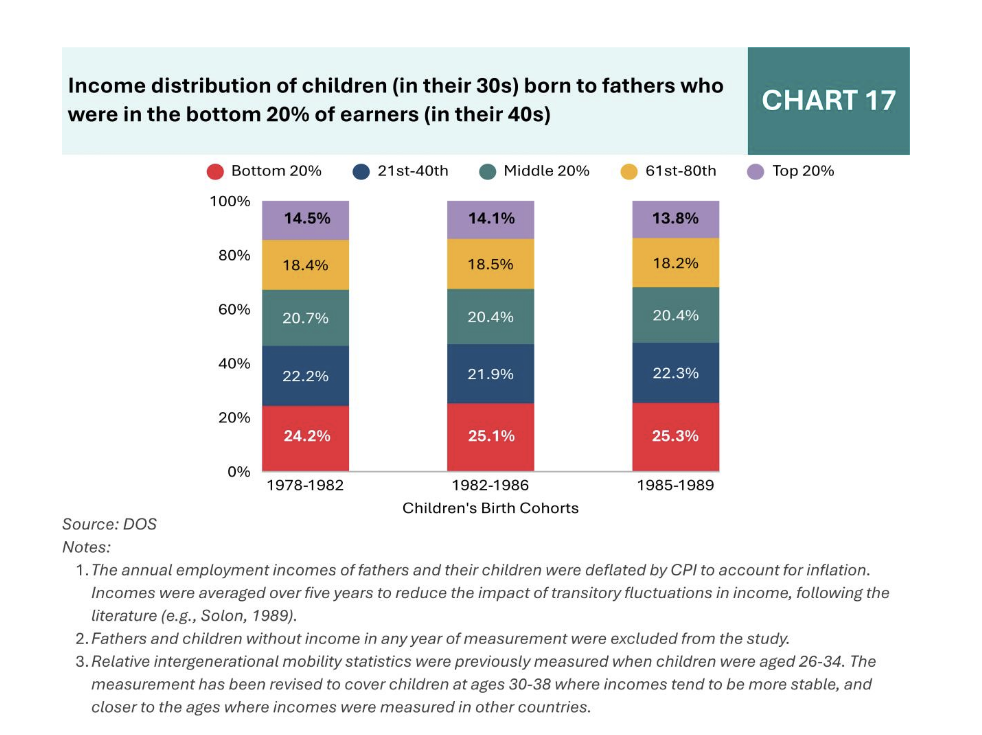
Singapore’s Government recently released a paper on inequality.
From Ministry of Finance
Amongst the headlines, wealth inequality has increased. And if we look at the red bar below, those in the bottom 20th percentile, were still stuck there. That proportion, had in fact grown.
For those of us who
are in social care, we want to help. Perhaps the easiest way to help, is to teach them to play the game of the rich.
I used to grow up angry that all my friends were so rich. Why didn’t they have to suffer like I did?
The turning point came when I started playing their game, and stopped complaining. For years, I thought the only way to grow rich was to study, get good grades, and then climb the career ladder.
Then I realised that I couldn’t fit well in jobs, because of how different I was.
This might be you. You’re sick and tired of social care,
but you don’t know where you can go.
Thus began my journey into making a business, which started in a field like social work, and trying to sell books and resources. That earns me a grand total of $200/year, which covers the cost of the websites.
Well, then came the second iteration - work on the writing skill I had. I wrote and wrote, and eventually earned $2000/month from freelance writing. Not a bad amount, but still not enough.
Then a
content agency. Still struggled with $900 a month.
But all throughout this time, the money I’d socked away as a 20-year-old investor just kept growing. And the stocks I bought with a thousand here, and another thousand there, grew. So I made an income not from any of the businesses I ran, but from the stocks I bought.
Stupid capitalist, you may say.
I agree. I am a stupid capitalist.
But sometimes, to win the big social
causes, to outlast the competition, you’ve to play the game you’re in. Only after playing can we then say that hey, this game was not worth winning.
I’ve met many social workers and socially-oriented people who say,
I hate money. I don’t need a lot of money.
Sometimes, that can feel like a cop-out. How do you expect to improve someone else’s life if you don’t even have the financial credibility?
Not that money solves all
things, but it does show you know how to play the game.
And you must play the game, to find the loopholes in the game, so that others can win it better.
So now, with struggling clients that really want change, I tell them to think about investing.
Don’t hate money. It’s just a tool.
Just because we care about our social causes doesn’t mean we have to hate money.