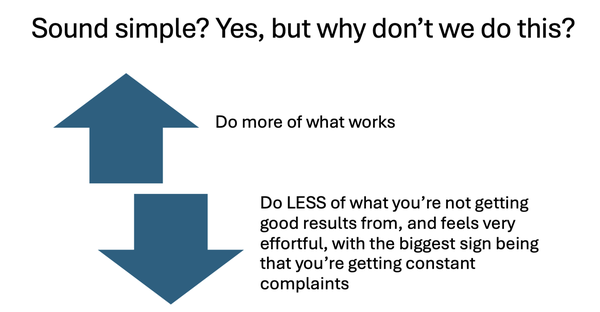
You probably have seen the same happen at work. Despite your best efforts, few turn up. You’re hustling, pushing your all, but you don’t get the results you want.
Our conventional wisdom tells us that we should push harder, and harder, grit and not give up! Look outside of the thing that’s not working, and you might just find something else working, without you putting in that much effort.
Things just happen.
For example, in 2021 October, I was asked to recontract as a social worker. But I knew that it wasn’t working out as easily as I’d wanted. Clients were complaining about me.
And I hated the admin work. It was not natural for me to chase down agencies, to follow-up on emails, and I hated sitting at the end of long bureacratic calls, trying to get a customer service officer to answer it.
When I moved onto writing, things
were tough at first, but within 6 months, I was writing for the national newspaper, and big banks like DBS. I was enjoying myself, and people were praising the work.
We talk alot about gritting, and not enough about quitting.
But sometimes, you should just give up.
But life has limited resources, and the more we give to the things that don’t work, the more we realise that we’ve less for the things that do work.
Of course, the
wisdom here is knowing when to quit, and when to grit. How do you know?
1 talk
If life has limited resources, why are we spending more effort on the ones that don’t work, rather than diverting it to the ones that do work?
1 tip
Of course the first step is to acknowledge it’s hard to distinguish when you should push and when you should pull back and drop out.
Because when you’re so far
inside, it’s hard to make a decision that’s best for yourself. There’s the sunk cost fallacy. And the fact that finding something new is going to be even harder.
Two ways.
Firstly, with jobs like social work and the helping profession, it’s good to have a discipline of rest, taking yourself away from the work, so that you can really tell if it’s something you enjoy.
One helpful thing is to take those regular 1 week breaks and to ask
yourself whether it’s something that you still enjoy.
When I look back at my journey leaving social work, it was the first 2 week break in December 2020, after 1.5 years of grinding that made me realise
oh, this is not something I want to do.
Secondly, if you find your work not bearing much fruit, it’s useful to just compare your wins and losses. If you’ve lost more than you’ve won, perhaps its worth looking at where there have
been places where things have come by more naturally for you.
When you work in your strength, and what you’re interested in, things flow.
Do work that aligns with you, not work that fights with you. You might just find yourself moving a lot faster.
John
Live Young, Live Well - Work Your Love